


You wake up and your lower back is just absolutely screaming.
Oh yeah, that is the worst feeling.
Right.
It’s that sharp electric shooting pain of a sciatic nerve flare-up that,
you know,
makes it hard to even stand up.
Yeah, it completely paralyzes your day.
Exactly.
But imagine instead of reaching for a bottle of pills or,
I don’t know,
scheduling an emergency physical therapy session,
you just pull on a specific shirt.
Just a normal looking shirt.
Well, woven right into the fabric of this shirt is this delicate, almost invisible
Visible Carbon Lattice and the moment it touches your skin it doesn’t just sit
there it literally intercepts your nerve pain which sounds completely wild it doesn’t just sit there it literally intercepts your nerve pain which sounds completely wild it really does because it uses a decentralized AI to actively and physically guide
your nervous system back to a state of absolute calm I mean I know it sounds
incredibly futuristic but based on the documents we have in front of us it is remarkably close to reality it is We are looking at an engineering system today that completely blurs the line between abstract computer science, thermodynamics, and, well, human biology.
And that is exactly the mission for this deep dive. We are looking at a really fascinating, highly technical stack of documents from June 2026.
It’s quite a stack, too.
Picture an investigative stack on a desk. We’ve got architectural blueprints, AI chat logs, specifically testing a system called Gemini 3, dense mathematical study guides, and an actual unedited meeting transcript between the two developers who are trying to build this thing.
And those developers, Colleen Pridemore and Christina Shriver, they’re tackling this problem from two completely different angles.
Right. Hardware and software.
Exactly. Which makes their collaboration really compelling to analyze, you know, seeing them try to meet in the middle.
Yeah. And all this work is happening under the umbrella of Violet Sight Systems, which is a disabled and female-founded organization. The project we are exploring today is their design for the Cognitive Somatic Regulator.
Though it was originally called a patch.
Yes. There is a great story about that name change that we’ll hit on later. But broadly, it is an ambitious wearable interface that bridges abstract AI software loops with the human physical nervous system.
Specifically targeting that awful sciatic nerve pain you mentioned.
Right. Okay, let’s unpack this. How do you actually translate computational AI models into real-world pain relief without just, I mean, blunt force shocking the nervous system?
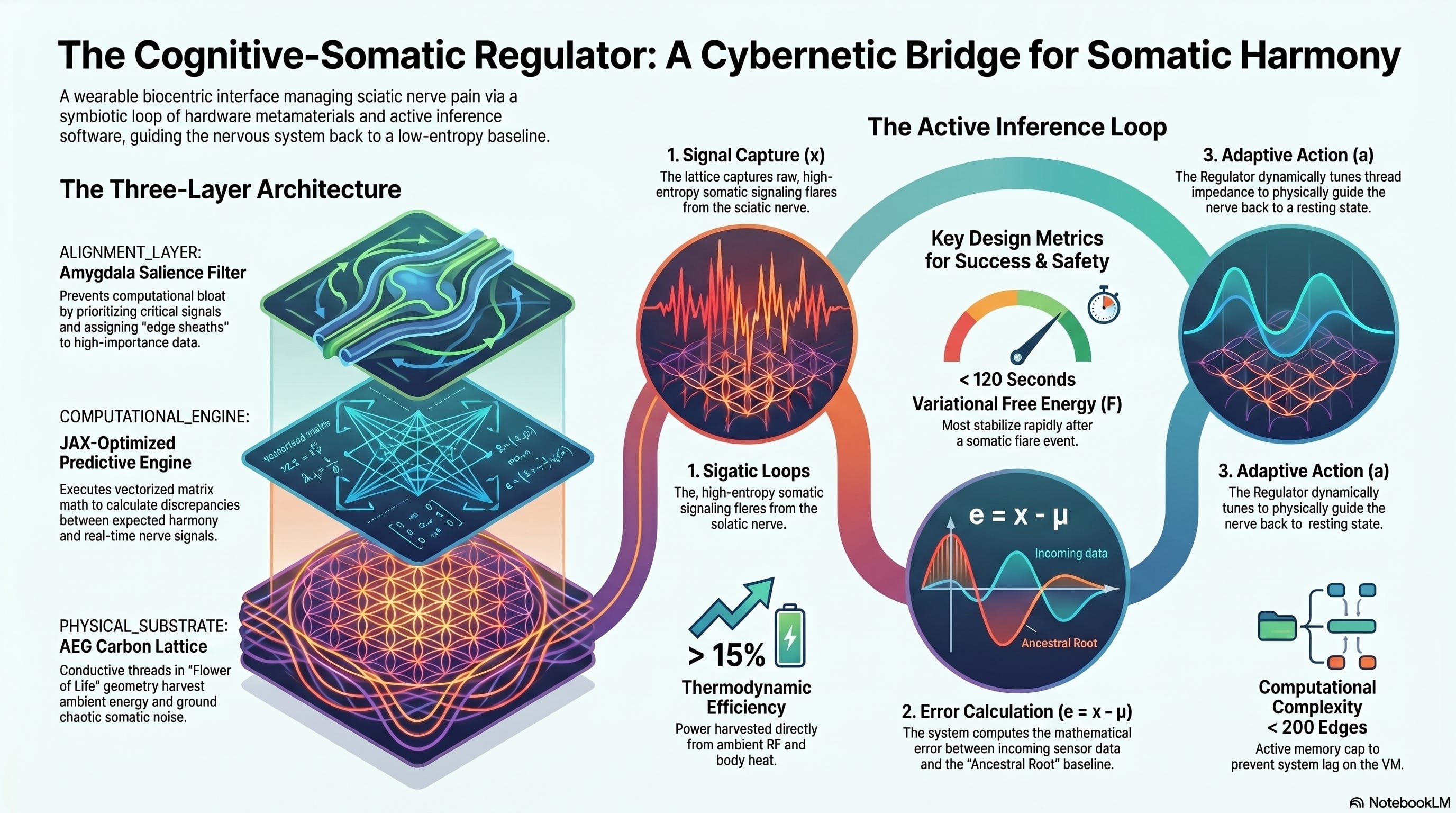
Well, that is the core engineering hurdle right there. And to understand the solution, we really have to start with the physical hardware. They call it the ambient energy garden or the AEG lattice. And this isn’t just, you know, a copper wire sewn into a cotton shirt.
So what is it?
It’s a physical substrate made of conductive carbon and graphene threads. But what’s really fascinating here is the geometry they chose. They literally etch these threads into a flower of life micro geometry.
The flower of life? Wait, you mean like that overlapping geometric circles pattern? The one you see in like ancient architecture on all the tapestries and music festivals?
That exact shape, yes.
No way. Are they just doing that for aesthetics?
No, not at all. It turns out that specific recursive geometry allows the carbon lattice to act as a highly efficient Passive Radio Frequency and Thermal Metamaterial Antenna.
Wow. Okay. That’s a mouthful.
It is, yeah. But basically, it sits directly on the skin over the path of the sciatic nerve. And it doesn’t just passively listen to the nerve. It acts as a thermodynamic grounding tool.
So what does a grounding tool do in this context?
It’s designed to absorb ambient electromagnetic noise from the room. And more importantly, it actually absorbs chaotic body heat and high entropy somatic pain signals straight from the user.
Wait, let me make sure I’m visualizing this correctly. It’s absorbing the heat and the electrical pain signals to power itself.
Yes, that’s exactly it.
That’s incredible.
Its design goal is to harvest at least 15% of its entire operating power just from this ambient noise and body heat. It takes all that chaotic static-like biological energy, grounds it, and transforms it into usable operating power for the system.
Huh. So if you think about noise-canceling headphones, they don’t just block sound, right? They have microphones that listen to the airplane engine, and then they actively create an inverse sound wave to destroy the incoming noise.
Right.
Is this regulator doing the same thing? Like, is it creating an inverse electrical wave to cancel out the pain signal?
Well, not quite an inverse wave in the way a speaker does, but your analogy is really strong. Instead of blasting an opposite wave, the lattice creates an energetic sink.
An energetic sink Yeah,
it alters its own physical resistance to draw that chaotic energy away from the nerve. It is capturing the physical components of the pain prediction errors.
But how does the device know when the nerve is acting up? Like, my headphones have microphones to hear the plane. How does this carbon shirt hear the sciatica?
Ah, so that brings us to the software side, the computational engine. And this is where Colleen Pridemore’s setup is just honestly wonderfully scrappy.
Scrappy how?
She is running this complex predictive coding network inside a Chromebook Linux virtual machine Wait,
what? They are running this on a Chromebook? Yep How is that even computationally possible given the math involved in real-time biology? I mean Chromebooks aren’t exactly supercomputers.
They’re not. But she gets away with it by using a framework called JAX. It’s a system that takes Python code and compiles it into highly optimized vectorized matrix math. So it runs incredibly fast, even Even on basic hardware.
Oh, okay, that makes sense.
Yeah, and the core of this JAX engine is constantly calculating a very specific, deceptively simple mathematical equation, E equals X minus mu.
Okay, E equals X minus mu. I’m guessing E stands for the ambient energy you mentioned earlier?
Actually, no, it’s a predictive coding equation, so E stands for error.
Ah, okay, error. So what do the other letters represent for the person wearing the shirt?
Mu represents the expected state of somatic harmony.
Okay, so like the baseline.
Exactly. It’s the AI’s baseline of what a healthy, pain-free nerve should look like. Low entropy, calm, predictable. And then X is the incoming sensor data from the carbon lattice.
Which would be the pain.
Right. That’s all the chaotic, high entropy pain data from a sudden sciatic flare-up.
I see where you’re going with this. So the error is the discrepancy between the peaceful state the system expects and the painful reality the nerve is currently experiencing.
Precisely. Under a framework known as the free energy principle, a biological system or an AI mimicking one wants to minimize that error. It wants to minimize the surprise of the pain.
Make the error zero, basically.
Yeah. So when the error spikes, the system executes what’s called an active inference action. It can’t just compute the math. It actually has to act on the physical world to fix the discrepancy.
And what does that action actually feel like? Because I got to say, if I have shooting pain in my leg, the last thing I want is a wearable device zapping me.
Oh, you wouldn’t feel a zap at all. It’s completely subsistence. Subsensory.
Subsensory.
Yeah. The system alters the physical electrical impedance of those carbon threads in the flower of life lattice. By dynamically tuning how much resistance those threads have, or by sending purely harmonic zero heat microcurrents, it physically entrains the sciatic nerve.
And trains it, like how two pendulum clocks on the same wall will eventually sync up their swinging.
Yes, that is the exact physical mechanism. The body naturally wants to sync with dominant, stable harmonic frequencies. Wow. By presenting a mathematically perfect, calm electrical rhythm right next to the chaotic nerve, the system literally guides the nerve’s electrical firing patterns back to a resting state.
It harmonizes the chaotic signals without the user ever feeling a blunt electrical shock.
Okay, that makes so much sense. It’s using advanced matrix math to essentially whisper a calming rhythm to your nervous system.
That’s a very poetic way to put it, yeah.
But, I mean, that physical design has to create a massive bottleneck. If this carbon lattice is constantly pulling in all this data ambient room temperatures, electromagnetic noise, heartbeat breathing, and every single twitch of the sciatic nerve, how does the system know what’s important?
Right. How does it not just get overwhelmed?
Exactly. Wouldn’t filtering all that instantly crash a scrappy Chromebook virtual machine?
It absolutely would. You would have computational bloat within seconds. The system would freeze up just trying to calculate the error of like a Wi-Fi router pinging in the next room.
So how do they fix that?
This is where Christina Shriver’s work comes in. She is the architect of the AI’s priority filter, which she calls the amygdala layer.
The amygdala layer.
Yeah, she built this for a decentralized AI framework called OpenCog, specifically working with its associative memory structure, which is known as atom space.
So they named it after the human amygdala, which, if I remember right, is the part of our brain that processes emotions, fear and survival instincts.
Right.
It tells us what to pay attention to in a crowded room.
Exactly. And in the unedited meeting transcript we looked at, Christina uses a really great analogy to explain this filtering to Colleen.
Oh, the toddler one.
Yes. She says, imagine a toddler touching a hot stove. That toddler is going to remember the pain of that fire infinitely faster and much more permanently than they are going to remember where they left a toy on the floor 10 minutes prior.
Right, because touching a stove has really high salience. It actually matters for survival. The toy doesn’t.
Yes. And biologically, when a neural pathway is used for something highly salient like that, the brain reinforces it through a process called myelination.
Myelination. That’s where it coats the nerve.
Exactly. It literally coats the neural pathway in a fatty sheath. And that makes the electrical signal travel much faster and more efficiently the next time that specific threat appears. So Christina is essentially building digital myelination into the software.
Here’s where it gets really interesting because I remember reading that part of the transcript. She assigns an edge sheath or a salience score to specific data points, right? So if the carbon lattice picks up a massive spike in nerve pain, the amygdala layer slaps a high salience score on it.
It artificially thickens that digital pathway so the system processes that pain spike instantly, completely ignoring the background noise of the room.
It dramatically increases the precision weight of that sensory channel, forcing the computer to prioritize the error. And what’s really beautiful about their meeting is the realization Colleen has during it.
Oh yeah, when they connect the dots.
Right. She realizes her physical carbon lattice is doing the exact same thing in hardware. Highly salient signals actually require less physical energy to sustain in the lattice if they match the system’s biocentric harmony. It’s a perfect reflection of software mimicking biology and hardware mimicking software.
Which actually leads to one of the funniest, most human moments in their transcript, I think.
Oh, the name Mix-Up.
Yes. Because they are approaching this from such different backgrounds, hardware and software, their vocabulary completely clashes. Colleen keeps calling her physical device a patch, the cognitive somatic patch.
Yeah, and Christina’s getting more and more confused as the meeting goes on.
Right. Finally, Christina admits she’s purely picturing a nicotine patch, like a chemical sticker that pumps drugs into your skin, or maybe a pad with blunt electrical needles.
It’s a classic engineering miscommunication. Christina just stops the meeting and says, wait, is this acting like little needles going in?
And Colleen immediately realizes her branding is entirely wrong. She decides right there on the call to rename it the regulator. Because, you know, it’s not dispensing a chemical drug, it’s regulating energy.
I love seeing that real-time problem solving in the transcript.
Me too. But, you know, reading through this, I did have a critical thought about this whole machine learning process.
Okay, what is it?
Well, for anyone listening who has dealt with chronic sciatica, you know that pain eventually just becomes a baseline. Your body gets used to it. So if the AI is constantly learning and updating its baseline based on what’s happening to the user’s body, isn’t there a huge risk there?
A risk of it normalizing the pain, you mean?
Exactly. What if someone has chronic, nonstop sciatic pain for a whole month? Won’t the system just eventually shrug, update its math, and accept that chronic pain as the new normal?
Well, if we connect this to the bigger picture, you have just identified the single most dangerous flaw in active inference systems.
Oh, really?
Yeah. In the study guides, they actually call it mundrift, or long-term data drift.
Moodrift, okay.
If the system experiences a prolonged high-entropy state like a month of severe inflammation, The rolling averages of its algorithms will slowly adjust. It will recalibrate to accommodate the noise, effectively blunting its own sensitivity.
Which defeats the whole purpose.
Yeah.
The system would go blind to the pain because the math now dictates the pain is supposed to be there.
Exactly.
So how do they stop the regulator from just giving up and letting you suffer?
They implement an absolute guardrail called the ancestral accountability heuristic.
The ancestral accountability heuristic. That sounds intense.
It is. Instead of letting the baseline update purely on recent feedback, the system constantly checks a multidimensional Jacobian matrix.
Okay, hold on. We’re getting deep into the math here. Can you translate Jacobian matrix for me? What is it actually looking at?
Sure. Think of the Jacobian matrix as a massive real-time dashboard of dials in a recording studio.
Okay, dials. I can picture that.
It measures how sensitive one part of the system is to a change in another part. So if I tweak the carbon thread’s resistance by 1%, how much does the nerve’s pain signal drop? The Jacobian maps out that current sensitivity across its physical sensors, its historical data, and its cognitive rhythms.
Okay, so it has this complex dashboard of how the body is currently reacting. But what is it comparing that dashboard to, you know, to prevent the drift?
Oh, wow. It is an uncorrupted zero entropy baseline for that specific individual person.
Ah, I get it. So it literally holds the body accountable to its own healthy past. So even if you’ve been in agony for three weeks and the local software is trying to adapt and accept the pain, the ancestral accountability heuristic kicks in and says, no,
I have the cryptographic proof of what your healthy baseline is and we are not shifting the goalposts.
That is exactly what happens if the active baseline drifts too far from that ancestral root. The system suppresses the algorithm’s updates. It forces the hardware to gently modulate its carbon thread impedance to pull the system back toward the authentic biological signature of the user.
That’s incredible.
It structurally prevents the AI from normalizing degradation.
That is genuinely brilliant. That is managed by a module they call the coherence validation gate.
You can think of it as the system’s mathematically enforced safety conscience. Before the AI is allowed to take any physical action, before it changes a single microcurrent in that carbon lattice, it runs a gate check formula.
Yeah, looking at the study guide, there’s this It’s a lot of math, I know. I’m going to admit, I don’t intuitively know what a determinant is doing in this context. Meaning what, practically?
It ensures that the system’s decision-making is stable across all three of those layers simultaneously The sensor layer has to clearly differentiate real pain from biological noise The historical layer has to prove this isn’t long-term drift And the cognitive layer ensures the adjustments match the user’s natural neurorhythms And if they don’t agree If any of those are unstable,
the score drops below 0.95 and the system absolutely refuses to act
So to use an analogy, it’s like a modern car’s traction control.
Oh, that’s a good comparison.
Yeah. If you hit a patch of black ice, the chaos or the free energy suddenly spikes. The car’s safety thresholds dynamically tighten. It won’t let you accelerate or brake too hard because the environment is unstable. The system becomes more rigid about what it will allow just to keep the driver safe.
Exactly. It locks down to prevent a spin out.
Right. But what happens to the regulator if it completely breaches those limits? Like, does the shirt just turn off or do you get locked into some weird error loop?
It has a built-in contextual auto-reset. If that safety threshold of 0.95 is breached for more than 120 seconds, the system doesn’t just crash or turn off completely. It safely executes what they call an inverse Jacobian transformation.
Inverse Jacobian yeah meaning what exactly running the math backward yes pretty
much it essentially unwinds the recent context and resets itself to the last known stable state it’s like hitting undo on a word document but for your nervous system Wow it’s a mathematical hard stop to prevent biophysical harm from cascading


